15 May 2011

Dorothy’s Power: Freedom

In The Wonderful Wizard of OZ, by L. Frank Baum the protagonist, Dorothy seems to have the capacity to set all around her free both physically and metaphorically. Dorothy does
not always spread freedom directly but the result of her actions leads to the freedom of others. Dorothy sets her tough and beaten down Aunt and Uncle free from the desolation and depression of the Kansas prairie with
her joy and innocence, “When Dorothy, who was an orphan, first came to her, Aunt Em, had been so startled by the child’s laughter that she would scream and press her hand upon her heart whenever Dorothy’s merry voice reached her ears” (13). Dorothy also sets the Scarecrow, Tin Woodman, and Lion metaphorical and physically free. She takes the scarecrow down from his post so that he can walk freely and she oils the Tin Woodman’s hinges so that he can walk again, “Oil my neck, first, replied the Tin Woodman. So she oiled it” (55).
fantasybooksandmovies.com
Though Dorothy’s determination to make it to the Emerald City to she enables the Lion, Tin Woodman and Scarecrow to receive the physical representations of what they felt they needed to have freedom in their lives, “Now you have a heart that any man might be proud of…I am very grateful to you, and shall never forget your kindness” (198). By the end of the novel, Dorothy has indirectly sets all of the land of OZ free from enslavement though her killing of the wicked Witches, “She was the wicked Witch of the East... She has held the Munchkins in bondage for many years, making them slave for her night and day. Now they are all set free, and are grateful to you for the favor” (23).

perkle.com
Dorothy clearly has an unusual gift in the novel to free all around her from the bonds that hold them back. Her qualities of courage, heart and brains coupled with innocence enable her to have this innate power.

Baum, L. Frank, and W. W. Denslow. The Wonderful Wizard of Oz. Mineola, NY: Dover Publications, 2002. Print.

publicdomainclip-art.blogspot.com

Away From Standard and Down to Earth: Disillusionment vs. Magic in Oz

L. Frank Baum’s “The Wonderful Wizard of Oz” begins with an illustration by W.W. Denslow that depicts Cowardly Lion sitting between two trees, as if confined. Just like this first picture, content of the book offers a vast interpretation behind the narrow definition of an innovative fairytale. The innovation brought by Baum is rather realistic, it does not fascinate the reader with an exquisite magic. “The Wizard of Oz” is a “down-to-earth” fairytale, because every time the narration leads into a height of phantasmagoria and the tone gets elevated, small details bring common sense to any slightest departure to the virtual realm. Abundant descriptions of food and the way Dorothy and companions recreate from adventures are put in contrast to the extraordinary in their characters.

Chapter seven presents the reader with a detailed description of the way Scarecrow picks food for the meal: “And the Scarecrow found a tree full of nuts and filled Dorothy’s basket with them, so that she would not be hungry for a long time….His padded hands were so clumsy and the nuts were so small that he dropped almost as many as he put in the basket”(Baum, 76). Scarecrow’s efforts to pick up the food teach the morale of not giving up, but at the same time the description of it takes as much space in the book as do the details about feats or, rather, “accidents” of the companions. All the routine processes of changing, sleeping and eating are depicted with care: “They slept that night on the grass, with nothing but the stars over them; and they rested very well indeed” (Baum, 221). The motif of disillusionment is enforced especially by seemingly meaningful additions to the plot. The powerful voice of Oz turns out to be a skillful ventriloquism, no more than a play of a humbug hiding behind a simple screen in the corner of the “great” wizard’s hall. An important moment when Oz was leaving the city is interrupted by an innocent cat chase. The great Wicked Witch of the West is merely afraid of darkness and water.Possibly, Baum meant to use this kind of irony to emphasize the value of small details that are present within defining moments, but are not paid attention to. The author debunks greatness through banal things.

A symbolic representation of the idea emerges when Scarecrow is sitting on the wall that surrounds china land. He is falling to the ground immediately to not let his friends be injured. Because Scarecrow is identified as a wise creature at that moment in the book, his falling brings back the fact that he is indeed a stuffed man only. Since his head is huge and round because of the bran “brain”, Scarecrow is associated with Humpty Dumpty from Lewis Carrol’s “Alice in Wonderland”, a character that deceptively rises, but whose crush is inevitable. It is interesting that W.W.Denslow, Baum’s collaborator, created illustrations for a book that contains a nursery rhyme about Humpty Dumpty. The concept of breaking of the charm in “The Wizard of Oz” is broadened trough breaking of the china figures as well.

Baum respects simplicity throughout the story as it attracts good luck and abbreviates struggles that could exist if all the adventures were perceived to be more defining than accidental. Dorothy’s soul, courage and mind are meaningful but at the same time her monologues and actions describe her as an ordinary frightened child.

Good and evil in the Wonderful Wizard of Oz

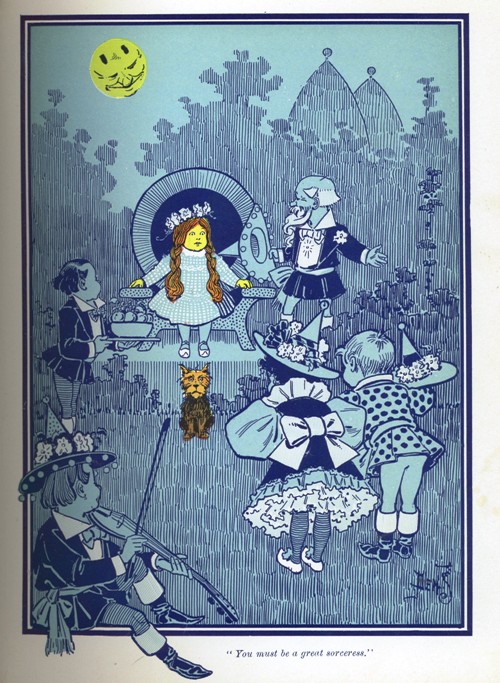
In the Wonderful Wizard of Oz by L. Frank Baum, characters are portrayed as either good or evil. The Witch of the South and North and the companions are good while the Witch of the East is evil. Kind, attractive, and white, the good witches help and kiss Dorothy. At Munchkin land, the Witch of the North is said to have a “hat [that] was white, and she wore a white gown that hung in plaits from her shoulders; over it were sprinkled little stars that glistened in the sun like diamonds” (20). The Witch of the South, Glinda has a “dress [that] was pure white” (254). Even Dorothy is mistaken as a sorceress as the Munchkins explain “you have white in your frock, and only witches and sorceresses wear white” (34). White is the indication of righteousness, so the good Witches and even Dorothy wear white. Both the good witches help Dorothy and give her a kiss. The Witch of the North “came close to Dorothy and kissed her gently on the forehead” (27) before Dorothy’s departs for her journey. The most powerful good witch, Glinda, is “both beautiful and young……her eyes were blue, and they looked kindly upon the little girl” (254). When Dorothy first meets Glinda, “Glinda leaned forward and kissed the sweet, upturned face of the loving little girl” (254). The kind, unselfish Glinda calls the winged monkeys to bring the companions and informs Dorothy the power of her shoes as she says “your Silver Shoes will carry you over the desert” (257).
Surrounded by darkness, the Wicked Witch of the East is evil, because she wants more power and enjoys torturing the companions. While the good witches wear white, the Wicked Witch is surrounded by black servants: the black wolves, crows, bees. The Witch is eager for power as she “made the Winkies her slaves, and set herself to rule over their country”, conducting dictatorship over the Winkies (146). Tortured by the Wicked Witch, the Tin Woodman is “battered and dented that he could neither move nor groan” (148). The Scarecrow’s straw is pulled out and the Lion is coiled in ropes “until he was unable to bite or scratch or struggle in any way” (148) Detailed descriptions of the harmed are illustrated to demonstrate the Witch’s evilness. Unlike Glinda who kindheartedly helps Dorothy, the Witch makes Dorothy her slave and even tries to steal her shoes as she thinks “if she could only get hold of the Silver Shoes they would give her more power than all the other things she had lost” (152), for she is unsatisfied and greedy for more.  
Though Dorothy kills both Witches, she is still good as the murders seem accidental. Dorothy’s house falls on and kills the Wicked Witch of the West. Though Dorothy does not conduct murder, the Winkies contributes the death of the Wicked Witch to Dorothy; therefore, Dorothy accidentally kills the Wicked Witch. Simple minded, Dorothy also seem incredibly innocent as she acts like children of her age. The time the Wizard demands the companions to kill the Witch, “Dorothy dried her eyes and said, ‘I suppose we must try it; but I am sure I do not want to kill anybody, even to see Aunt Em again’” (135). Though Dorothy has to murder the Witch, she expresses that she “does not want to kill anybody” (135). This good, naïve child is forced to commit murder when only she just wants to go home. Another time the Wicked Witch steals Dorothy’s shoes, in range Dorothy pours a bucket of water nearby, which melts the Witch. Terrified by what she have done, Dorothy expresses “’I’m very sorry, indeed’ said Dorothy, who was truly frightened to see the Witch actually melting away like brown sugar before her very eyes” (154), clearly suggests Dorothy does not know water melts the Witch. Her act is unintentional as she apologizes for the murder. While she should be celebrating the death, she feels bad about killing and is frightened by her unplanned act.
Works Cited
Baum, L. Frank. The Wonderful Wizard of Oz. New York: Dover, 1960.

14 May 2011

Colors in the Land of Oz

Color is something that we encounter all the time, everyday. It is something that we don’t always appreciate. In the Wizard of Oz, I noticed a theme of colors representing different lands. The Emerald City is represented by the color green, Munchkin Land is represented by the color blue, Quadling Country is symbolized by red, Winkie Country is symbolized by yellow and the Wicked Witch’s domain is represented by the color black.

The color green is associated with jealousy and envy; however, there is also a different aspect of the color, green can also symbolize growth and nature. The Emerald City could represent growth because Dorothy, the Scarecrow, the Tin Woodman and the Lion are able to grow into the people they aspire to be, mentally and physically. Each companion, except Dorothy, physically obtains what they desired, but they already had what they wanted,

they just did not realize they already had their gifts. Dorothy also grows to her full potential, she gains a loyalty to her comrades that she never had before. She easily left the Scarecrow in the river and the Lion in the poppy field when she was traveling to the Emerald City so she could find a way back to Kansas. However, after staying in the Emerald City, Dorothy says that she must find the Scarecrow and the Tin Woodman after the Wicked Witch destroys them. She also brings food to the Lion each night when he is the Wicked Witch’s prisoner risking her own life so he will not starve.

Munchkin Land is the color of water and the sky, and these ideas have two opposing connotations. Water can symbolize stability, a clear path and calmness but it can also symbolize uncertainty and disorder. The sky can represent heaven, which goes along with the concept of faith, and serenity but it is known to be a symbol of turmoil and confusion when there is a storm. Munchkin land welcomed Dorothy when she arrived to the Land of Oz. They gave her a clear path on how she can get home. The Wizard of Oz is not a religious book, but the concept of faith could give Dorothy a sense of purpose and something to believe in. This is exactly what Munchkin Land does for Dorothy; it gives her hope as well as a solution to get back home to Kansas. However, there is also another side to Munchkin land, even though the Munchkins provide her with clear directions; they cannot help her in any other way. There is a lot of uncertainty in her plan, she does not know her way around Oz and she does not know what the Wicked Witch is capable of doing.

It is ironic that the Winkie Country is represented by the color yellow because yellow is connected with the sun which implies joy and happiness. The Winkies, however, are enslaved by the Wicked Witch, and cannot make their own decisions meaning they have no independence or freedom. The color black represents the Wicked Witch, which is linked to power and evil, both of these traits characterize the Wicked Witch. The Wicked Witch craves power, and wants to be seen as evil; however, she is creating a facade so people will be intimidated by her.

The Quadling Country is represented by the color red, which is the color of fire and blood, and embodies energy, strength, power, danger and passion. This is where Dorothy finally figures out how to get home, and I think this is where Dorothy and her companions finally gain their strength. The Lion becomes the King of the Animals, the Scarecrow is going to rule the Emerald City and the Tin Woodman is going to rule over the Winkies. The Quadling Country, though, does not pose any danger to Dorothy and her companions which makes you question Baum’s original purpose of using color to represent the lands of Oz, maybe he did it on purpose, or maybe it is just a coincidence.

Ozian Studies Postings

Fans of or newbies to L. Frank Baum's (& W.W.Denslow's) The Wonderful Wizard of Oz:  Enjoy the analytical musings of the ten scholars in Paired Texts.  The pairing, you ask?  Check back soon for postings that compare the original story with its progeny, Wicked by Gregory Maguire.

12 May 2011

Communism in Oz

The story of The Wonderful Wizard of Oz by L. Frank Baum is a universal tale that can be viewed in many different lights. One of the most common ways to view the story is as an allegory for political parties. Baum himself never acknowledged that his story was based on anything besides his active imagination and his desire to create a modern fairytale, but critics throughout history have made countless connections to his story. When I read the book the first connection that I saw between the story and the real world was the idea of communism. This idea may have been emphasized by the 1939 movie as well because Ithink the movie definitely takes the communist connections within the book and emphasizes them.

Although during the time the book was written communism was not a prevalent issue, as communism grew in popularity during the 20th century people started to make connections between The Wonderful Wizard of Oz and communist views. The idea of the common people banding together and taking the place of the authority figures scared some American audiences. During the Cold War America thought that communism (i.e. the Soviet Union) was the enemy and their biggest fear was communism spreading to the U.S. Anything that even slightly resembled communist propaganda was banned in the U.S. However, in 1939 the book was made into a movie by director Victor Fleming and was hugely successful. I find this interesting because there is blatant communist propaganda throughout the film. From the shape of the yellow-brick-road to the portrayal of the Wizard of Oz, many elements of the movie reflect communist views.

In both the movie and the book, Dorothy and her companions are common working class citizens that, by the end of the story, replace the previous establishment.The traits of courage, heart, and intelligence were portrayed as the core values of a good working-class citizen at a time when so many people were living in fear of good working class citizens who simply had a different view of what society should look like.Americans banned the book The Wonderful Wizard of Oz for many years because they did not want their youth to be “corrupted” by communism. However, one wonders why the movie was so popular while at the same time the book was being condemned. The movie was made at the start of World War II, when different media outlets were first being used as a means to convey propaganda to the public. At the time, America did not see the communism within the movie, but when you really think about the message that the movie is sending you cannot help but see at least one aspect of communist theory.

Works Cited

Baum, L. Frank, The Wonderful Wizard of Oz. New York: Dover, 1960.